Friday, May 28, 2010

THE OIL DOLLARS TRAGEDY


I've suggested previously that "The Dollars Trilogy" provides an alternative narrative for New Labour's time in office: please see my post of 17 March. However, "The Oil Dollars Trilogy" may provide a more appropriate description of the years between 1997-2010, when the so-called US-UK "Special Relationship" dominated so much of the governance of Britain.

It is, therefore, a tragic twist to this narrative that "The Oil Dollars Trilogy" should end with a failure of governance on the part of the US administration in regulating the activities of British Petroleum in the Gulf of Mexico. For it turns out that BP were exempted from the provision an environmental impact assessment prior to the sinking of the deep sea oil well whose subsequent leakage has brought catastrophe to the area. Had this precautionary principle - see my post of 30 April - been adopted, the subsequent narrative might have been very different.

Saturday, May 22, 2010

AND NOW FOR THE GOOD NEWS....

The new Treasury team has apparently found ample opportunity for making saving in public expenditure. This comes as no surprise to those of us who have observed the growing gravy train in recent years.

However, profligacy is not the whole story. Some areas of government do operate efficiently.

Quangos are clearly one of the problem areas. The Regional Development Agencies, for instance, have evolved an oligarchic relationship with certain sections of the business community in areas like the West Midlands.

As a former minister for this region, the previous Chief Secretary to the Treasury, Liam Byrne, was an important contributor to such collusion.

We should not be surprised, therefore, that his administration should have left the coffers empty.

Tuesday, May 18, 2010

"THERE'S NO MONEY LEFT"

This was former Chief Secretary to the Treasury's hand-over message to successor David Laws.

Monday, May 17, 2010

NEW UK POLITICS CLOUDED BY ASH....

There must be something about New Labour politics which offends the Old gods of the North, for no sooner have the Miliband brothers announced plans to stand as leadership candidates, than the Icelandic ash cloud returns to the skies above Britain.

However, it was Lord (Paddy) Ashdown who looked like thwarting the New Politics of a Conservative-Liberal Democrat coalition last week, along with former Prime Minister Gordon Brown. In short, the UK electorate was being asked to support a so-called "Progressive Alliance", whose leader would be appointed after the Labour Party decided a successor to Brown, who by then had conveniently offered to resign.

I'm sorry, but most of the ordinary voting public wanted a leader elected by the people, a mandate to which new Prime Minister David Cameron has most claim. My guess is that such a "Progressive Alliance" could well have be deemed unconstitutional, and that the Liberal-Democrats took the only real course of action open to them in joining the Government, a move which was endorsed by their conference last weekend.

Thursday, May 13, 2010

Week In Politics Nearly Not Long Enough !

Some general reflections on the UK Elections to follow shortly.

Monday, May 10, 2010

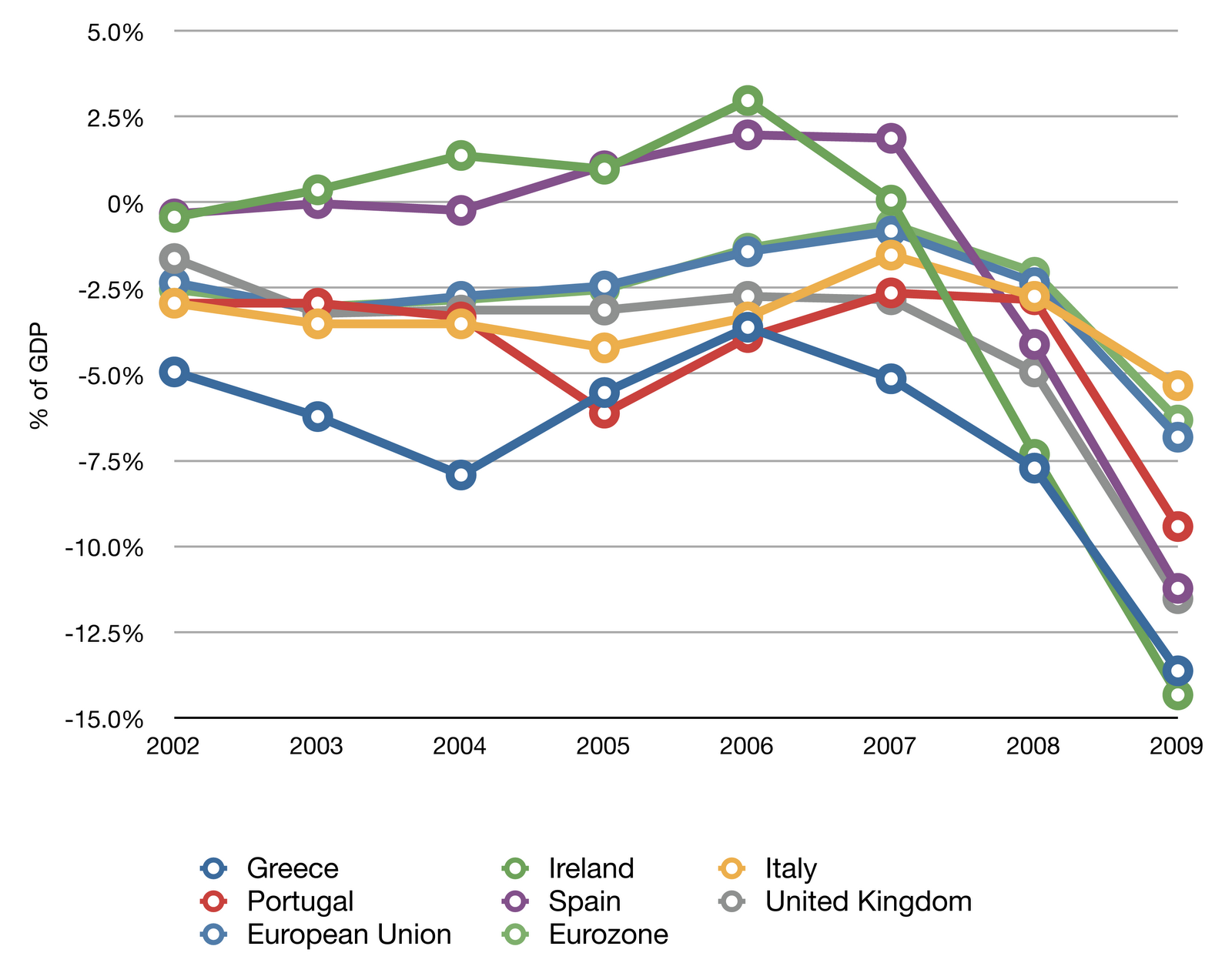
EUROPEAN SOVEREIGN DEBT CRISIS

The Government Deficit/Surplus of Greece, Ireland, Italy, Portugal, Spain and the United Kingdom in relation to that of the Eurozone and the European Union between 2002-2009 (Source 2010 European Sovereign Debt Crisis Wikipedia).

Acropolis Now was how The Economist Magazine recently described the Greek Debt Crisis. However, the "European Stabilisation Mechanism" agreed by EU Finance Ministers this weekend is also a response to the wider Sovereign Debt Crisis across Europe. Nor is this problem confined to the Eurozone, for the crisis again threatens contagion across the international banking system. Whilst the markets have responded positively to EU's actions - which are not proving popular amongst the prudent Germans - the threat of moral hazard has raised itself once more, with protection of necessity being afforded to the imprudent.

This is precisely why British politicians need to closely follow Lady Prudence and swiftly form a government capable of tackling economic and financial problems at home and abroad. The role of the opposition in this process will also be crucially important.

Friday, May 07, 2010

UK ELECTIONS - DEAL OR NO DEAL ?

Conservative leader David Cameron needs to do a deal with the Liberal Democrats, offering Nick Clegg and Vince Cable positions in a "Balanced Cabinet", and giving Ken Clarke the role of Deputy Prime Minister.

In the absence of this, the likely scenario is that Gordon Brown will be back, as New Labour performed better than the newly Lib-Dem media anticipated.

Thursday, May 06, 2010

Terminator Needed for UK Elections

Whatever the outcome of today's General Election, I'm sure most people would share my view that we don't need another one in the near future. So whether a single political party emerges as the winner, or there is a hung parliament, our elected leaders should get on with the job of running the country.

Tuesday, May 04, 2010

Schwarzenegger Terminates Drilling Plans

The Governor of California's announcement earlier this week to suspend the expansion of oil drilling off the US West Coast is good news, particularly given the financial problems confronting the State. These share some similarity with those of Greece, although California remains one of the world's major economies.

In contrast to the lack of action by the United States Government in dealing with the problems of the Gulf of Mexico, the move by Schwarzenegger reflects the positive side of the US federal system. The Governor of California has also led action on energy and climate change issues.

Saturday, May 01, 2010

WEAKNESS OF US GOVERNANCE MODEL

The reaction of the United States Government to the catastrophic oil spillage in the Gulf of Mexico reveals the weakness of the US model of governance. In short, legal retribution is the name of the game. This approach may be more effective than other models in dealing with consequences of financial wrongdoing, as in the case of banks, but when the environment is at stake pre-emptive and prompt practical action by the appropriate public authorities is essential. Once again, the US Government has been lacking in the this regard, as it was with New Orleans before Hurricane Katrina.

Friday, April 30, 2010

Importance of the Precautionary Principle

Less than a fortnight ago, much of Europe was grounded by the eruption of an Icelandic volcano. The airline business was swift to complain that European civil aviation officials were overly cautious, but most people would prefer this kind of disruption to a calamitous accident.
At around the same time aircraft were returning to British skies, the rig component of a deep sea oil well and pipeline complex belonging to BP - British Petroleum - exploded in the Gulf of Mexico, killing 11 people. However, the possible wider impact of this incident does not seem to have been fully acknowledged by the company, the US Coastguard, or the government in Washington....until too late.

This failure to fully acknowledge the potential consequences of the oil rig explosion at the time of the incident may have been due to a number of factors, including the impending announcement of BP's annual profits and the United States Government's plans to extend drilling in the Gulf.

Whatever the reason, the outcome may be the US's worst ever environmental disaster, bringing devastation to marine and other wildlife, as well as to the livelihoods of people engaged in industries such as fishing and tourism.

The economic collusion of big business and national governments is always a clear and present danger, as the recent banking crisis has revealed. This is precisely why the precautionary principle and timely intervention by regulatory authorities are so important in disaster prevention and management, even if this time it's the environment, stupid !

Thursday, April 29, 2010

The Shadow Side of Political Correctness

One consequence of Gordon Brown being off-message and on air yesterday was that British National Party Leader Nick Griffin was on air and on message this morning on the BBC's Today Programme.

Wednesday, April 28, 2010

The Importance of Real People's Concerns

Gillian Duffy's retort to Gordon Brown's off-air - but actually on - description of her as a bigot was that he needed to meet more real people.

The context was a prime ministerial visit to Rochdale today, and Mrs Duffy is a former Labour supporter with concerns about the economy and social justice, although she didn't use the latter expression. Like many other people, she is also concerned about immigration to the UK. In short, Mrs Duffy expressed the kind of concerns which most pollsters have found characterise the British electorate.

What the Prime Minister's faux pas - for which he has apologised - reveals is the political correctness gap, or perhaps that should be gulf, between ordinary people and those in positions of power who have been the major beneficiaries of New Labour's social engineering project, of which mass immigration has been a key component. To express disquiet about this runs the risk of being labelled "that bigoted woman" as Brown described Mrs Duffy.

The fact that Gillian Duffy is a traditional Labour supporter makes today's encounter all the more interesting. Although I once hoped that the future ex-prime minister would do a "Tony Blair" and pretty much disappear from British public life, my present feeling is that he should retire gracefully to the back benches and spend more time in the company of real people.

Tuesday, April 27, 2010

Business backs Clarke for Chancellor

News agency Reuters reports today that Ken Clarke is the favoured candidate for next Chancellor of the Exchequer amongst UK business leaders. This is hardly surprising, as Clarke steered the economy from the last recession, and British politics is short on experience just now. Ken Clarke has also stuck around, although rebuffed as contender for the Tory leadership, in stark contrast to the leading architect of New Labour, former Prime Minister Tony Blair.

Saturday, April 24, 2010

Ken Clarke Reveals Tory Terms For Deal

According to a Press Association report today, the Shadow Secretary of State for Business Industry and Skills has said the bottom line for a deal with the other political parties would be adherence to the Conservatives planned deficit reduction programme, involving early massive cuts in public expenditure.

The timing and scale of public expenditure reductions is a defining difference between the Tories and the other main parties, and Clarke has also expressed doubt that these would accept the Tory proposals.

However, a legacy of "moral hazard" (see below) also applies to much of the public - and publicly funded - sectors under New Labour. In short, there has been a great deal of profligate spending and too little accountability when things have gone wrong. The problem is that the casualties of public spending cuts will not be, in the main, the people who made the wrong decisions.

Nevertheless, I do very much support Conservative proposals to scale down The Quango State, although even Mrs Thatcher found this difficult. Nevertheless, as a previous Chancellor of the Exchequer as well as Secretary of State for Health, I do regard Ken Clarke as someone capable of administering radical surgery of the kind most people accept is required sooner or later.

Friday, April 23, 2010

THE NEW DUKES OF MORAL HAZARD

To celebrate the restoration of "The Image" to my blog, I'm returning to the 1980s auto theme with which the present British General Election campaign started. I'm referring, of course, to the David Cameron-Gene Hunt-Audi Quattro image for which "Dave" expressed his thanks to New Labour spin.

The Dukes of Hazzard was a real (as distinct from retro) US TV show of the late 1970s-mid '80s, with 2 main heroes - a bit like the contemporary partnership of David Cameron and George Osborne - and an attractive woman in hot pants, not as yet sighted amongst those Cameronettes....but now the weather is hotting up, who knows what might happen.

"Moral Hazard", I fear. For I'm not convinced that David Cameron's Conservatives will tackle this problem arising from the bail-out of UK banks and the protection of bankers from bearing the real consquences of their risk-taking. I also detect a return of the Conservative pre-occupation with the less fortunate amongst the feckless, at a time when it is the morals of the wealthy and powerful that most need regulation.

Tuesday, April 20, 2010

BLACK SWAN FLIES INTO LONG CRISIS ?

Yesterday, I was reminded of Black Swan Theory - see www.fooledbyrandomness.com - and today hit upon a website called www.longcrisis.com Black Swan Events are unpredictable happenings which have an impact of great/wide magnitude, and whose occurrence and effects are later rationalised as predictable: the consequences of volcanic eruption(s) in Iceland serve to illustrate the theory very well. The forecast "Long Crisis" encompasses changes arising from increasing global connectivity, with particular reference to financial/economic systems, climate change and "peak oil" and the need to adjust to these environmental limits to growth. Political leadership will be a key factor in determining how societies like our own adjust to the challenges ahead, and this is precisely why Britain needs a very different kind of politics at the present time.

Monday, April 19, 2010

An Ideal UK General Election Outcome ?

The prospect of a genuine coalition government involving all the major, and some of the minor, UK political parties is looking more attractive to many people, including myself. However, there is a possibility that such a government would not be run by any of the current political party leaders. In a situation where the Conservatives had most seats followed by the Liberal-Democrats, my guess is that Ken Clarke might prove the most acceptable prime ministerial candidate, with Vince Cable as the man who would be Chancellor. It strikes me that these are two men who could do business with one another, to paraphrase Mrs Thatcher's description of her relationship with former Soviet President Gorbachev. At the present time, the UK needs more experienced leadership than that offered by David Cameron who, as former Number 10 advisor Mathew Taylor pointed out on BBC Radio 4's The World at One today, did not appear to demonstrate much real passion or enthusiasm for office in the three party leadership debate last week.

Saturday, April 17, 2010

WE ARE ALL IN THIS TOGETHER !

"Global Gridlock" is how Australian ABC News describes the impact on world air travel of the volcanic ash plume across northern and central Europe.

Forecasters are now suggesting that the climatic conditions which have contributed to the problem could continue into next week.

The volcanic ash plume is an environmental event of global significance, a so-called "Act of God" which at best is an inconvenience for users of air transport, and at worst a disaster.

However, unlike recent earthquakes, there do not seem to have been any direct fatalities as yet from the eruptions in Iceland.

What this episode should do is make people - and policy makers in particular - think more laterally about the potential for and impact of "Nature's Great Events".

Please also see http://the-deep-stuff.blogspot.com

Friday, April 16, 2010

A week is indeed a long time in politics....

By any stretch of the imagination, the past seven days has been an extraordinary week for international and domestic politics.

I wonder if Iceland's volcanic ash plume would have so effectively grounded North Western Europe had the pilot of Poland's ill-fated presidential plane followed Russian air traffic advice and diverted from Smolensk to Minsk last weekend ?

Meanwhile financier and philanthropist George Soros has warned of the possible break-up of the European Union if Germany and other countries fail to support the financial rescue of Greece and similar failing economies more wholeheartedly.

Sounding a positive note, the Washington summit on nuclear arms control earlier this week has been widely hailed as a success.

On the domestic front, I listened to yesterday's first live broadcast "debate" between the leaders of Britain's three main political parties on the radio, which conveys a rather different impression to television.

I have to say that there was something about the format of this event which wasn't entirely satisfactory, although I agree with the general view that Liberal Democrat Leader Nick Clegg emerged as the "winner".

As I missed the end of the broadcast, I'm not sure whether environmental issues were discussed. However, I have to say that the silent skies outside more than made up for this !